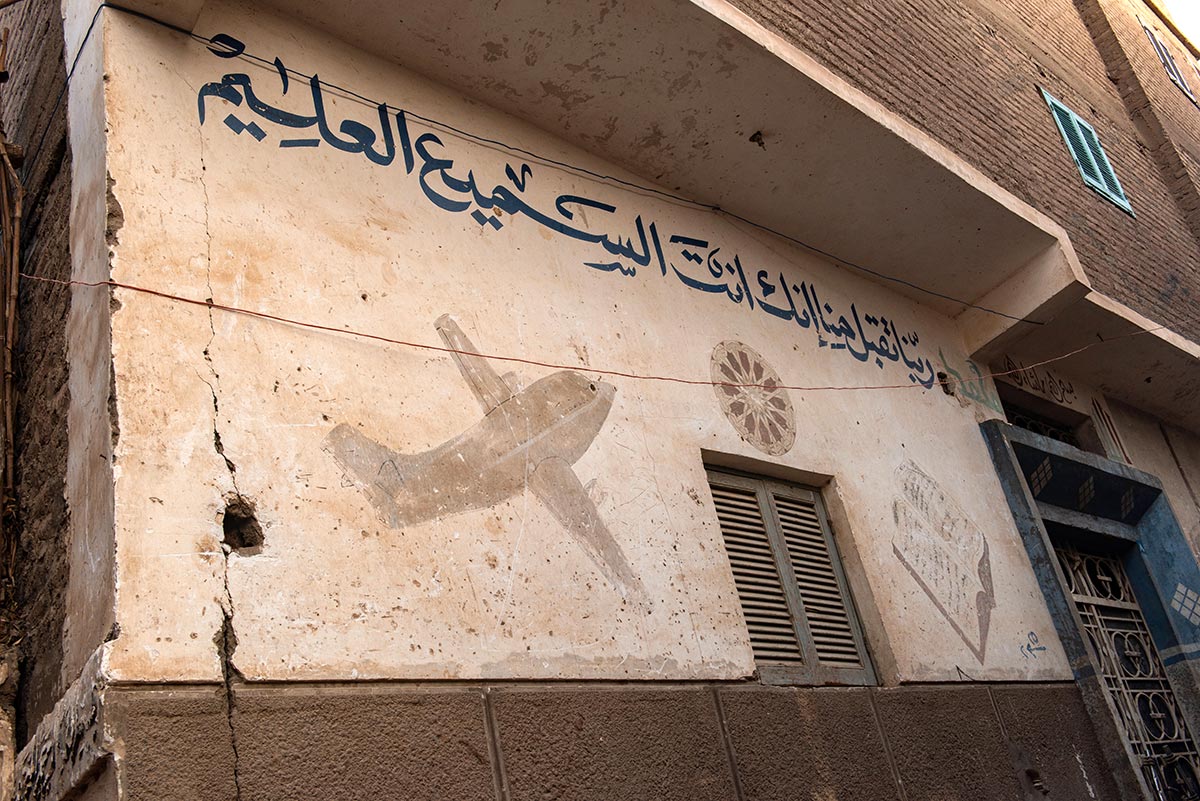
The artifact photographed by Ayman Damarany is a graffiti-like painting on walls and homes mostly found in small towns of El-Araba and El-Ghabat near Abydos, Egypt.
·
The painting depicts a recording of the Hajj, or
Muslim Pilgrimage to Mecca. The paint includes the member's name, year, and mode
of travel to Mecca.
·
The material used varies from paint, spray paint,
or chalk.
· For Muslims, Pilgrimage to Mecca is a big deal and could be conducted at least once in one's lifetime. The painting shows social communication, commitment, and devotion for their religion by relaying who, when, and how they went to Mecca.

This graffiti painting by Chemis was painted on a school wall in Prague, Czechia (Czech Republic) in 2014
·
The artist's goal for painting "Each One Teach One" is to
show how we, as a society, need to teach those young and old.
·
The artist used multiple paints and colors to
depict his mural.
·
The meaning of the mural is that we should teach
all the way of life. Everyone is capable of teaching the younger and older
generation about life, especially in the times that we live in from the racial implications.
· The cuneiform letter in the Assyrian dialect of Akkadian was a personal letter to the king of Egypt.
· The material used was a cuneiform clay tablet written with a reed stylus.
· The cuneiform tablet was meant to open communications with the king of Egypt and make peace with the major superpower of the region.
Chemis (2014). Chemis, page 4 [Painting]. Art Crimes. https://www.graffiti.org/chemis/chemis_4.html
El-Kurru, S. (2019). Graffiti as devotion along the Nile:
El-kurru, sudan [Painting]. Graffiti as Devotion | About the Exhibition. https://exhibitions.kelsey.lsa.umich.edu/graffiti-el-kurru/about.php
Hayes, William C. (1959). Scepter of egypt II: a background
for the study of the egyptian antiquities in the metropolitan museum of art: the
hyksos period and the new kingdom (1675-1080 B.C.) [Painting]. Cambridge,
Mass.: The Metropolitan Museum of Art, pp. 295–96, fig. 182.
Comments
Post a Comment